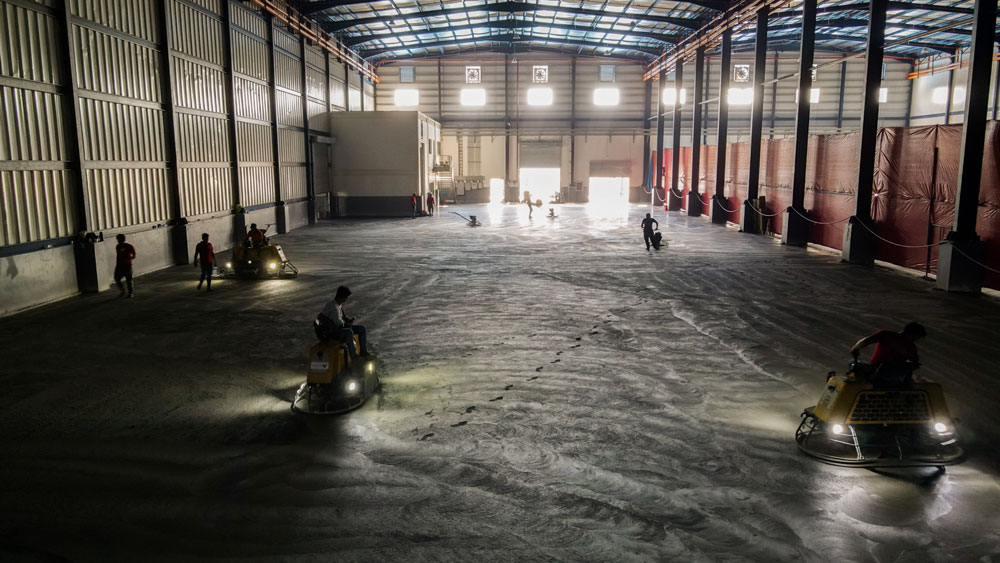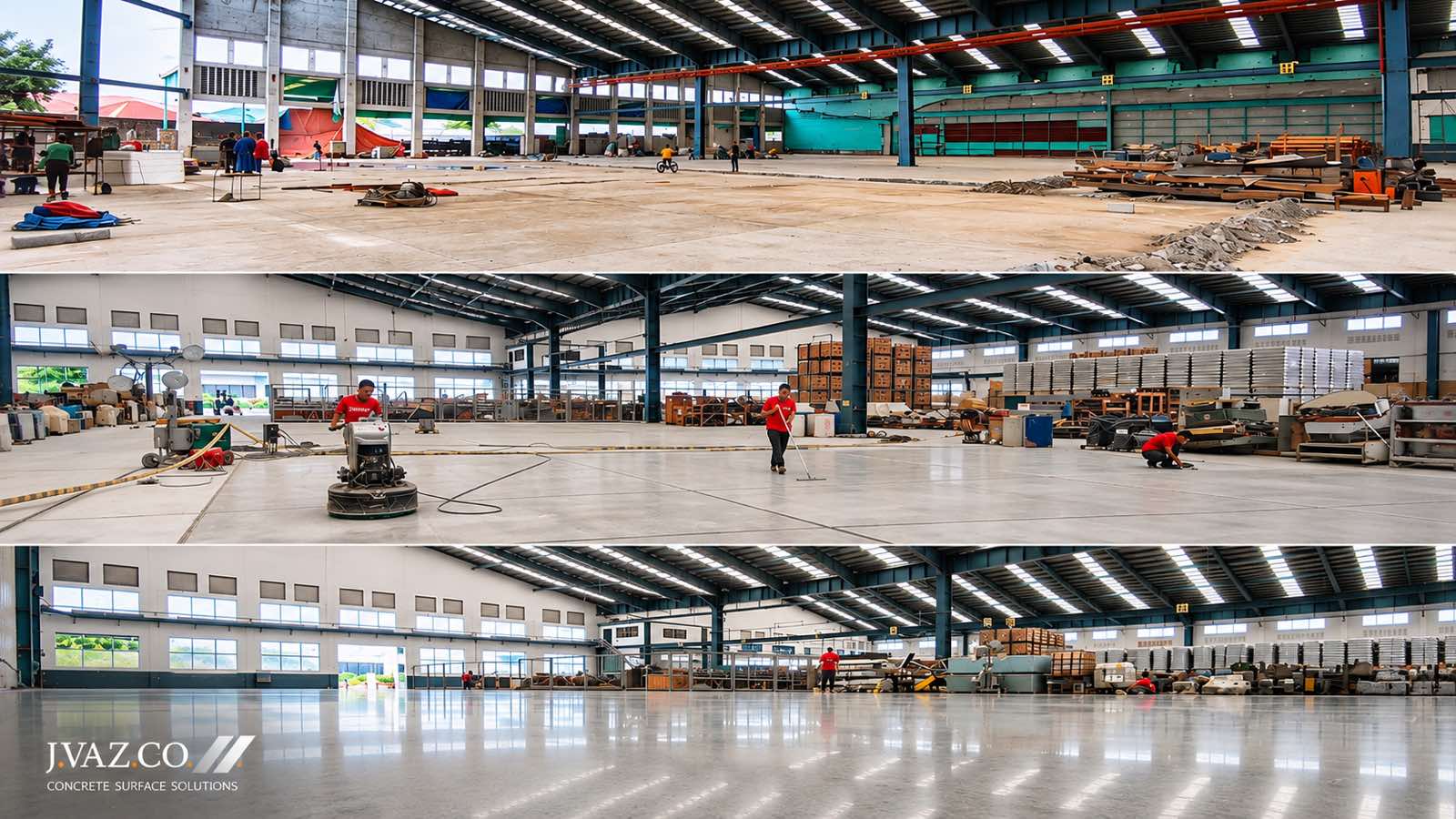
Ground, honed, and polished concrete are often used interchangeably in construction specifications, BOQs, and project briefs. However, they represent different stages of mechanical concrete surface treatment, each with distinct applications, appearance characteristics, and performance requirements.
Understanding these differences is essential to specifying the right floor, managing project costs, and achieving the intended result.
The Concrete Finish Spectrum
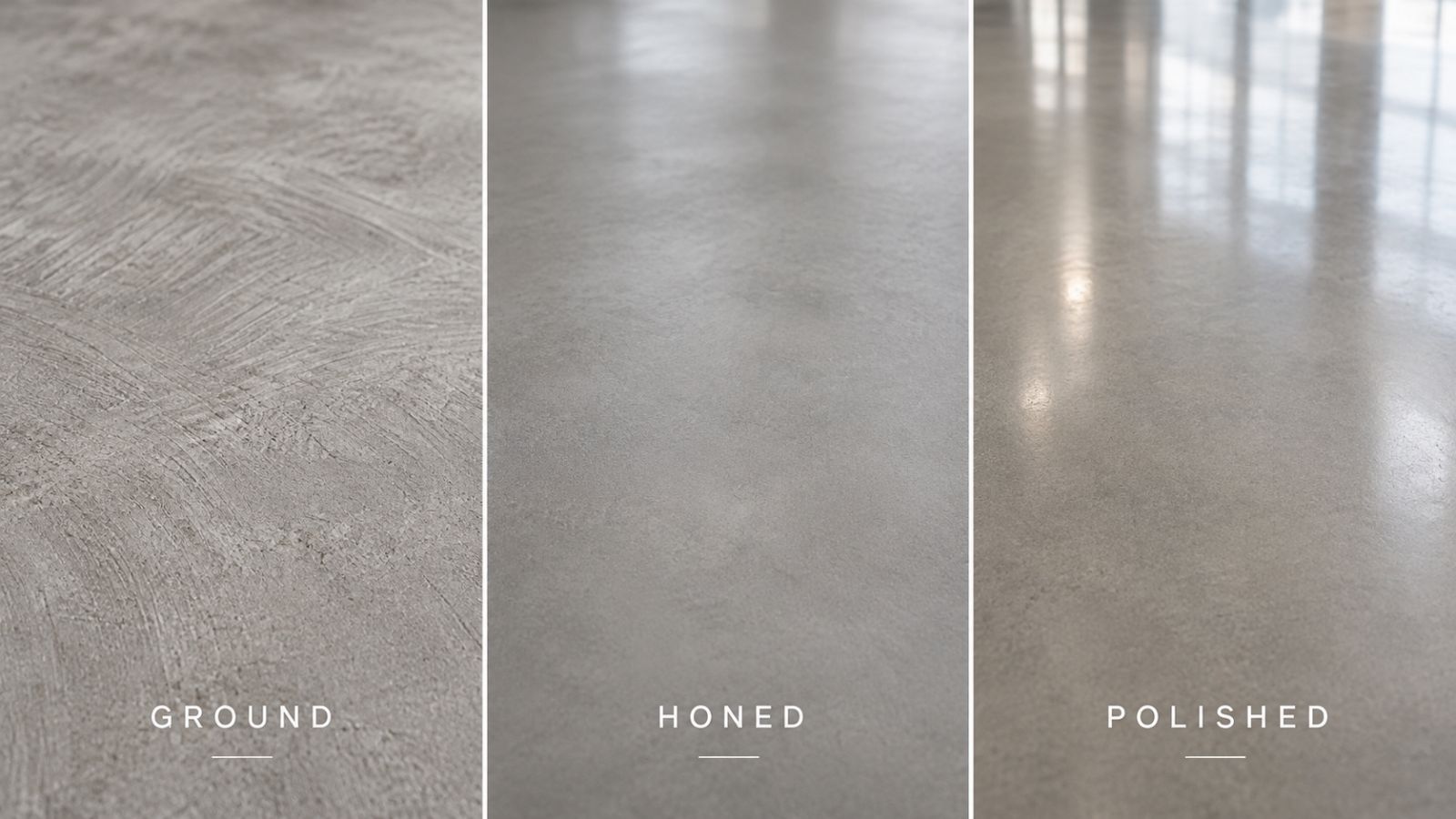
Mechanical concrete finishing uses diamond-bonded tooling in progressively finer stages. The final appearance depends on the tooling sequence, aggregate exposure, concrete condition, and the level of refinement required.
Before mechanical finishing, it is important to distinguish a troweled cream finish. This is developed during fresh concrete placement and finishing, producing a smooth cement-paste surface. On cured concrete, minimal grinding can expose a similar cream appearance, depending on the slab’s condition and finishing history.
1. Ground Concrete: Coarse Grinding
Grinding is the initial stage of mechanical concrete surface preparation. Using coarse diamond tooling, typically ranging from 25 to 100 grit, the objective is to remove surface irregularities, existing coatings, contaminants, or deteriorated concrete.
Grinding is particularly important when preparing a slab for epoxy, polyurethane, or other coating systems. The required Concrete Surface Profile (CSP) depends on the coating manufacturer’s specifications. Insufficient profiling can compromise mechanical adhesion and contribute to coating delamination or peeling.
Common applications:
- Epoxy and coating preparation
- Removal of existing coatings and adhesives
- Surface leveling and concrete restoration
- Preparation for toppings and protective systems
Grinding is primarily a surface preparation process, not necessarily a decorative concrete finish.
2. Honed Concrete: Surface Refinement
Honing continues the refinement process using finer diamond tooling, commonly progressing through approximately 100 to 400 grit. It produces a smoother, refined surface with a matte or low-sheen appearance.
Honed concrete is suitable for environments where functionality, durability, and a subdued aesthetic are priorities. Its appearance is generally less reflective than polished concrete, making it a practical option for industrial and commercial spaces.
Common applications:
- Warehouses and logistics facilities
- Parking structures and service areas
- Commercial back-of-house spaces
- Industrial facilities
3. Polished Concrete: Progressive Refinement
Polished concrete progresses beyond honing through increasingly finer diamond tooling, typically ranging from 800 to 3000 grit. The process develops a denser, more refined surface with progressively higher reflectivity.
A chemical densifier, such as Nano-Lithium by Convergent, is applied during the polishing sequence. It reacts with available calcium hydroxide in the concrete to form additional calcium silicate hydrate (C-S-H), increasing surface density, improving abrasion resistance, and helping reduce concrete dusting.
Typical diamond grit progression includes:
- 800 grit: Refined sheen with moderate reflectivity.
- 1500 grit: Higher gloss with more defined reflections.
- 3000 grit: Very high gloss, depending on concrete condition and finishing procedures.
Aggregate exposure is another important specification. Cream exposure retains primarily cement paste, while salt-and-pepper exposure reveals fine aggregates near the surface. Greater grinding depth can expose larger aggregates, depending on the concrete mix and aggregate distribution.
CPC Concrete Appearance Classification
Diamond grit alone does not determine the final appearance of a polished concrete floor. The Concrete Polishing Council (CPC) classifies concrete appearance using measurable characteristics, including Distinctness of Image (DOI), Gloss Units (GU), and Haze.
| CPC Level | Appearance | DOI (%) | Gloss (GU) | Haze |
| Level 1 | Exposed / Flat | 0–9 | Below 10 | Below 12 |
| Level 2 | Exposed / Satin | 10–39 | 5–25 | Below 12 |
| Level 3 | Polished | 40–69 | Above 35 | Below 12 |
| Level 4 | Highly Polished | Above 70 | Above 50 | Below 12 |
Source: Concrete Polishing Council (CPC) Appearance Chart, American Society of Concrete Contractors. These appearance classifications are independent of fixed diamond grit stopping points.
Choosing the Right Concrete Finish
Selecting the appropriate finish depends on the intended use, maintenance requirements, operational conditions, and desired appearance.
- Warehouses and Logistics: Honed or mechanically refined finishes for functional, durable surfaces with manageable maintenance requirements. Additional coatings may be necessary for specific chemical or hygiene requirements.
- Retail and F&B: Satin to semi-gloss finishes for a refined appearance that balances aesthetics and maintenance.
- Corporate Offices: Semi-gloss finishes for a clean, contemporary, and professional environment.
- Showrooms and Hospitality: High-gloss to highly polished finishes where reflectivity and visual impact contribute to the architectural design.
On-Site Finish Verification
When JVAZCO verifies a completed polished concrete floor, surface measurements are taken on-site to confirm compliance with the specified appearance level.
Testing includes Gloss Units (GU), Distinctness of Image (DOI), and Haze, using appropriate calibrated instruments and applicable ASTM test methods.
Measurements are conducted before post-polished surface treatments are applied, following CPC measurement guidelines.
A concrete floor must meet its specified performance criteria, not simply look polished. Visual appearance alone is not sufficient to establish compliance with a polished concrete specification.
At JVAZCO, concrete finishing is approached as both a technical process and a design consideration, ensuring that every floor is specified, executed, and verified according to its intended application.
References
- Concrete Polishing Council (CPC), American Society of Concrete Contractors. CPC Appearance Chart
- Convergent. Pentra-Sil NL Technical Data Sheet
Concrete Matters
Articles, perspectives, and ideas from the people shaping the concreting industry.